
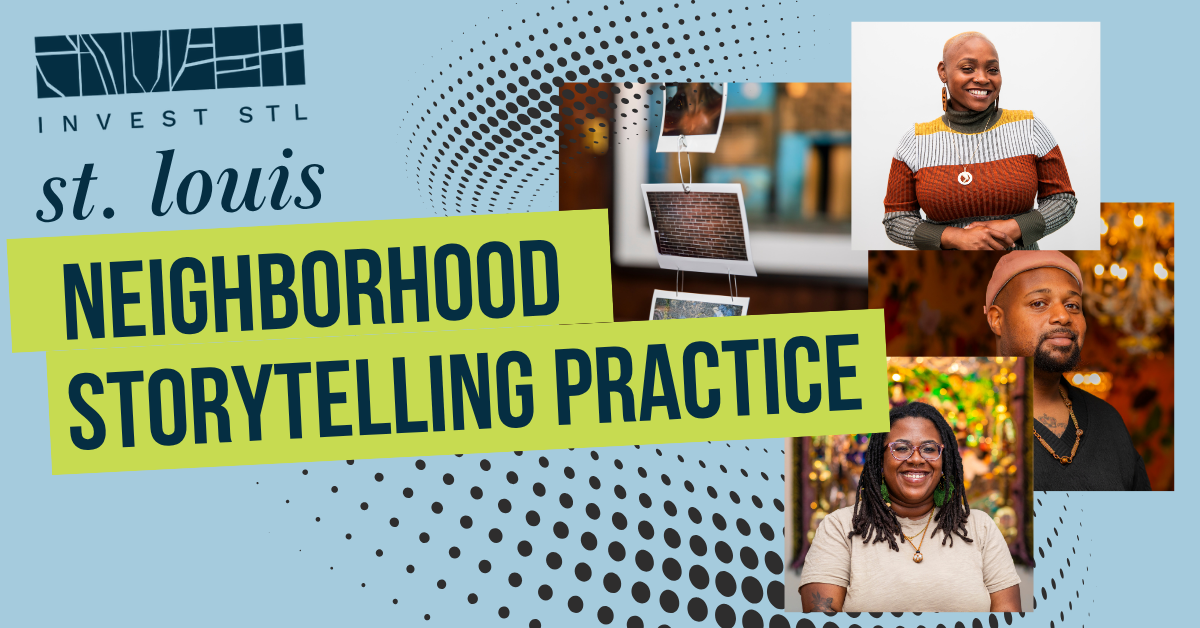
Every neighborhood holds stories that rarely make headlines.
Those stories live on front porches and sidewalks, in family traditions and home gatherings, in memories passed from one generation to the next. They’re carried by the people who know the rhythm of the block, the names of neighborhood elders, the history behind vacant lots, and the joy found in community celebrations. And they’re sustained by those who have shaped a place — not simply by living there, but by caring for it, investing in it, and imagining what it can become.
Invest STL created the St. Louis Neighborhood Storytelling Practice (NSTP) from a simple belief: the people who know their neighborhood best should have the power to tell its story.
Over nine months, 13 Resident Storytellers (cohort participants) who live in, work in, or are deeply connected to Greater Ville, Kingsway East, and The Ville are exploring what it means to document their stories with curiosity, care, and intention. Together, they’re building a practice rooted not only in storytelling, but also in healing, reflection, and collective imagination.
Why NSTP?
The Neighborhood Storytelling Practice bridges the gap between external narratives and lived realities by supporting North St. Louis Black neighborhoods and mobilizing and collaborating with residents to create, collect, and share stories that reflect their communities — in all their complexity, beauty, and dreams. We do this by nurturing a network of resident storytellers who can identify, shape, share, and circulate these narratives, broadening and enriching how Black St. Louis communities are represented, understood, and valued across the region. Ultimately, we strive to transform how the region shares narratives about, views, and values Black St. Louis residents and their communities.
Through this practice, cohort participants are:
- Reclaiming the narrative by shifting storytelling power back to residents.
- Building a living archive that preserves neighborhood history, culture, and everyday experiences.
- Equipping local voices with the tools, relationships, and creative space to strengthen their storytelling practice.
Storytelling as a Practice
NSTP is more than a storytelling workshop. It’s a structured, place-based immersion into observation, deep listening, and creating together.
Throughout the practice, participants engage in memory mapping, oral history, place-based storytelling, creative exploration, one-on-one mentorship, and collective reflection. Each experience encourages residents to slow down, notice what often goes unseen, and document the richness already present within their communities.
The work is grounded in a shared understanding that storytelling isn’t static — it’s an active tool. Stories create connection by reminding us that our neighbors’ experiences deeply intersect with our own. They help communities celebrate their strengths while honestly examining their challenges. Most importantly, stories create change by exploring what’s possible and helping shape new futures anchored in community wisdom.
What We’re Learning
Rather than producing stories about people and their neighborhoods, NSTP is cultivating stories with people about their neighborhoods, and working to share those to the broader region and beyond — with permission from the Resident Storytellers — to reframe narratives about Legacy Black St. Louis neighborhoods. The process and journey matter just as much as what is produced, creating intentional space for creativity and shared learning.
NSTP Resident Storytellers aren’t only creating stories — they’re seeing themselves differently. Storytelling has become a way to strengthen relationships, preserve community memory, and recognize lived experience as a form of sacred knowledge.
“As a member of the Design Residency that helped give birth to the Neighborhood Storytelling Practice, it is a beautiful sight to see our neighborhood storytellers engaging in the broad variety of storytelling methods presented by creatives from the St. Louis area. The practice has just gotten started, yet, I can see how it is already transforming what the neighborhood storytellers believe is possible, how they see themselves, and their neighborhoods. To bear witness to this type of reclamation in real-time is an honor.”
– Cheeraz Gormon, NSTP Co-host
“The Neighborhood Storytelling Practice is doing revolutionary work in real time. We are seeing how courage, honesty, and transgenerational camaraderie create the container for critical conversations, vulnerable transformation, and collective accountability for our participants, guides, and host team.
The inaugural practice is divinely timed, with each guide opening a new corridor of wisdom, artistry, and critical connections for our participants as they weave their memory, vision, and voice into a living archive of healing, witnessing, and transforming themselves, their lineage, and their neighborhood. I’m grateful to be a witness and a part of this incredible process.”
– Lauren Pickett, NSTP Co-host
Looking Ahead
As the St. Louis Neighborhood Storytelling Practice continues to evolve, Resident Storytellers remain committed to creating stories, documenting neighborhood history, and learning from one another. They’re challenging who gets to shape the public narrative about St. Louis and its Legacy Black neighborhoods. Through their participation in key community and regional inflection points, Resident Storytellers will create distinct and varied outlets for stories to be experienced and interacted with, and will facilitate regional awareness of and engagement with stories across neighborhood boundaries and institutions. In doing so, they demonstrate that storytelling is more than documentation; it’s an act of care, a form of leadership, and an investment in the future.
Acknowledgements
This work doesn’t happen alone. It’s about collaboration with community partners. We’d like to thank everyone who helped make the St. Louis Neighborhood Storytelling Practice possible.
We’d like to begin by thanking our 2024 Design Residency Fellows – Corey Barnett, Ronda Smith Branch, Dail Chambers, Victoria Donaldson, Cheeraz Gormon, Shawn Harrell, and Basmin Red Deer — for the creativity, wisdom, and care they brought to this work. We also want to honor the life and legacy of Basmin Red Deer, whose contributions to the residency and to our community will be remembered with deep respect.
We’re grateful to our curriculum creators, Ronda Smith Branch and Hero Harrell, whose expertise, thoughtfulness, and intention helped bring this vision to life.
We’re honored to recognize our collaborators, Black Healers Collective and We Soul Cool, for helping us nurture and uplift cohort participants’ experiences throughout this initiative.
We’re deeply thankful for our NSTP Hosts, Cheeraz Gormon and Lauren Pickett, for holding space throughout the cohort’s nine-month journey and shepherding both the individual and collective storytelling experience.
We also extend appreciation to our NSTP Guides – Marvin-Alonzo Greer, Darian Wigfall, Dante Barger, Aida Ade, Lance Thurman, Dail Chambers, Dr. Paulette Sankofa, Gundia Locke-Clay, Thomasina Clarke, Tracy Stanton, Dr. Roz Norman, and Darrious Varner – who support our Resident Storytellers in developing their storytelling skills and voice.
Last, but certainly not least, we’re especially honored to recognize our inaugural NSTP Resident Storyteller cohort — Almetta Cookie-Jordan, Armon Walker, Damaris Bacon, Ellen Usher, Erin Renee Roberts, Julia Allen, LaCole Purley, Pancho Rucker, Sheila Rendon, Sherri Bailey, Shirley (Kim) Watt, Tea Ruffin, and Tyrone Johnson — who are the witnesses, weavers of threads, and keepers of their neighborhoods’ heartbeat. We’re grateful to them all for trusting us to provide space for them to claim their creative authority as the primary storytellers of the world they inhabit — and to help shape how their communities are seen, understood, and remembered.
