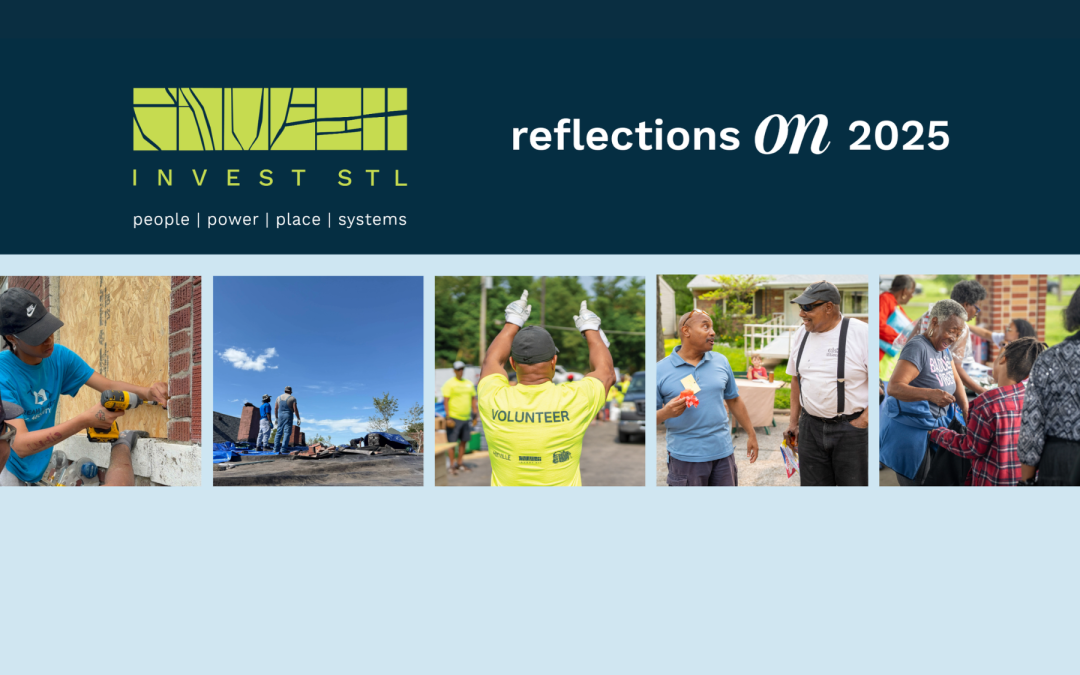
As an organization committed to a clear end date (2042), we are constantly viewing time in three directions: what we seeded in the past that we can nurture in the present to yield meaning in the future. Looking back, in 2024, I was nagged by the question of enough (effort, understanding, care, ingenuity, investment, etc.). What a difference a year makes.
When 2025 began, we were rounding home on the first phase of our 20-year timeline (Laying the Foundation). It was to be a final year of slow and steady, marked by calm and clarity. But 2025 had much, much more in mind. Driving northbound to a meeting on May 16, I watched the sky turn heavy with green. Team members were watching the same from our office windows. In the miles of neighborhoods between us, in barely an hour, the very heart of Black St. Louis would be forever changed. For so many families and communities alike, plans and dreams were shaken loose and scattered with no roadmap for what was next. But the years of forged relationships, shared memories, kind gestures, and aligned purpose remained in the soil. And like those families, thousands of neighbors, and countless organizations, we put it all to work.
Freshly inked investment partnerships were leveraged to provide collective care through the 4theVille Emergency Hub, anchored by 4theVille, Invest STL, and Dream Builders 4 Equity in daily collaboration with Action St. Louis and ForTheCultureSTL for The People’s Response. Instead of launching new pilots as intended, we doubled down on our learnings from previous efforts and launched the Northside Resilience Fund with capital from longtime backers and new supporters, all seeking to provide timely, flexible cash aid for our neighbors navigating the unimaginable. And the Small Dollars Action Fund, delivered in partnership with SLACO, was a steady source for residents organizing, showing up for, and doing as they saw best for their neighborhoods. The pace and scale at which we’ve tried new ways of doing (resident-led planning, Rooted, Small Dollars Action Fund, etc.) and accelerated development and usefulness of key relationships prepared us to be nimble and responsive immediately following the tornado. There was enough familiarity and credibility for us within the ecosystem and the community to be a collaborator and steward of meaningful action in the midst of major unknowns.
Our actions post-tornado only heightened and broadened our relationships, understanding, utility, and credibility, setting a firm foundation for our arc. Indeed, it was 85% good enough to show up with and for our community and launch us into the next phase of our 20-year timeline: rapid trying of bold ideas with purpose. Now, those careful plans that were swept up into a whirl and rightly set aside are being dusted off and retooled in a year that makes them even more relevant and urgent for the present and the future. For Invest STL, our 2026 forecast includes:
A compliment to the continuum of resident-focused trainings offered in the region by way of our place-based Neighborhood Action Incubator to strengthen and catalyze networks of residents organizing and moving together to shape their neighborhoods
Our first trying of a Neighborhood Storytelling Practice, a collective-centered invitation for residents to uncover, bring forward and amplify their own experiences of being in and keeping a place together
A pilot effort to restore value to homes in legacy Black neighborhoods, with the intentions of providing families with the equity needed to affirm home as their generational wealth cornerstone
Elasticity and spaciousness to show up and do as best we know how alongside so many other committed organizations and residents, to forge a future for North City, unfogged by the tornado’s debris
It turns out just enough was there all along, waiting to prove itself when the time called for it. Our foundation is set, firm enough yet a little spongy for the give that’s required to be the most useful with what and who we have in responding to the moment at hand, while not losing shape or intention for our mission. In 2025, practicing our principles and not sticking to rigid formulas revealed the integrity of what we’ve cultivated so far. In 2026, it will illuminate the new possible, one untethered from the past and reaching toward a community worthy of our lifetime.
As a descendant of Mississippi sharecroppers that made their journey to The Ville, one of St. Louis’ legacy Black neighborhoods, Catherine Knights has called seven STL neighborhoods home throughout her lifetime, though she is choosing to call Vandeventer home.
The Ville has been home to legendary people and institutions, such as Sonny Liston, Chuck Berry, Tina Turner, the Homer G. Phillips hospital, and is the birthplace of Catherine Johnson, now Mrs. Catherine Knights.
Her journey from The Ville, took her through St. Louis neighborhoods like Cochran Projects-Cochran Garden, Laclede Town, Central West End, West End, Wells-Goodfellow, and now she calls Vandeventer neighborhood her forever home. Continue reading to learn why Catherine has chosen to call Vandeventer home for the past 45 years, and why she plans to for the rest of her days.
“The Vandeventer neighborhood is a prime location to live in due to its proximity to everyday essentials that a family would need, space that businesses can operate within, and access to recreational opportunities,” according to Catherine.
Catherine shared with Invest STL that she could move elsewhere such as Seattle, where her husband, a doctor of 30 years, resides. Perhaps she would have chosen a place with less harsh seasons. That would allow her to be out and about more as someone with more mobility needs than she once had, but she doesn’t see herself ever leaving Vandeventer.
Having nice neighbors that look out for each other is one of the reasons that Catherine loves her neighborhood, along with having shade trees in her yard to shield from the St. Louis summer sun.
Catherine’s favorite thing about Vandeventer, other than her neighbors and beautiful yard, is the historic and memory-filled home that she has owned and invested love and care into for 45 years.
When it comes to neighborhood involvement, Catherine is no stranger to her neighbors or her neighborhood.
Catherine shared, “When I moved to the house in 1979 I immediately sought out the community organizations and joined SLACO almost at its founding in 1980. I have been a member ever since.
I’ve served on neighborhood organizations and block units continuously as a member and officer. I am now Secretary/Treasurer of the Vandeventer CDC.
When Catherine is not doing things with her neighbors, she is tending to neighborhood needs – not just for the people she calls neighbors, but the animals she calls neighbors as well! As Catherine is the self proclaimed cat lady of her neighborhood!
Catherine shared that she doesn’t like the way that Black neighborhoods are portrayed in St. Louis from the news and other media outlets. She believes that, “People need to have positive learning to have an opinion on a place,” which is part of why Catherine and her neighbors, Barbara Murphy, Yvonne Carter, and Judith Arnold applied for the Small Dollars Action Fund, a funding opportunity provided by Invest STL and SLACO that has been designed to provide funding that activates neighbors to connect and engage with one another.
Their neighborhood collective were awardees of the Small Dollars Action Fund in the fall cycle of 2023.
To learn more about The Small Dollars Action Fund please visit this link. The SDAF will open again in January, so there is some time to take a look around and get a couple of your neighbors together to plan your spring activities now. Check our website or email [email protected] for any questions regarding when the cycles are open and closed.
The Invest STL team is appreciative of the time, energy, and storytelling that Mrs. Catherine shared with us. Her stories, background, and a glimpse into why she chooses Vandeventer help enrich our understanding of community and home.
For more information on how you can get involved in Vandeventer please visit the Vandeventer CDC website, and stay up to date with what is going on in Vandeventer by connecting with their page on Facebook.
Want to get active in your neighborhood, but not sure where to look? Check out the neighborhood map located in our Neighborhood Toolbox.
“This is not just a dream or something that is so far away that you can’t reach. This is happening in our community and it’s happening with people that are here.” – Star Stinson, West End resident and Rooted participant. Watch the Fox 2 story to learn more about Rooted: Cultivating Black Wealth in Place and how the new initiative from Invest STL is supporting residents’ ability to stay and grow in the place they call home.
The Rooted initiative hopes to create “a multi-generational approach to wealth building” by providing $20,000 to 50 participants that live in the city’s West End or Visitation Park neighborhoods who applied and qualified for the grant. Each participant will have access to free services including financial planning, credit counseling, and estate planning. Click here to read the whole article from the St. Louis American.
In recent years, the West End and Visitation Park neighborhoods of St. Louis have begun to see signs of gentrification. These historically Black communities are experiencing increased economic investment, rising rent and housing prices, and a growing white and higher-income population. Absent any intervention, these forces of economic development and chance could displace long-time Black residents.
However, one nonprofit community development intermediary and funder in St. Louis, Missouri, Invest STL, is piloting Rooted, Cultivating Black Wealth in Place, an initiative aimed at combating displacement in two historically Black neighborhoods. The Urban Institute is evaluating the program to assess its impact on displacement risk and wealth building. The analysis will also uncover financial planners’ role in helping beneficiaries pursue these outcomes. And if this pilot is successful, scaling it could help address the racial wealth gap more broadly. Click her to read the whole story from the Urban Institute’s blog Urban Wire.