Standing in the Gap: How the Northside Resilience Fund Came Together

Standing in the Gap: How the Northside Resilience Fund Came Together

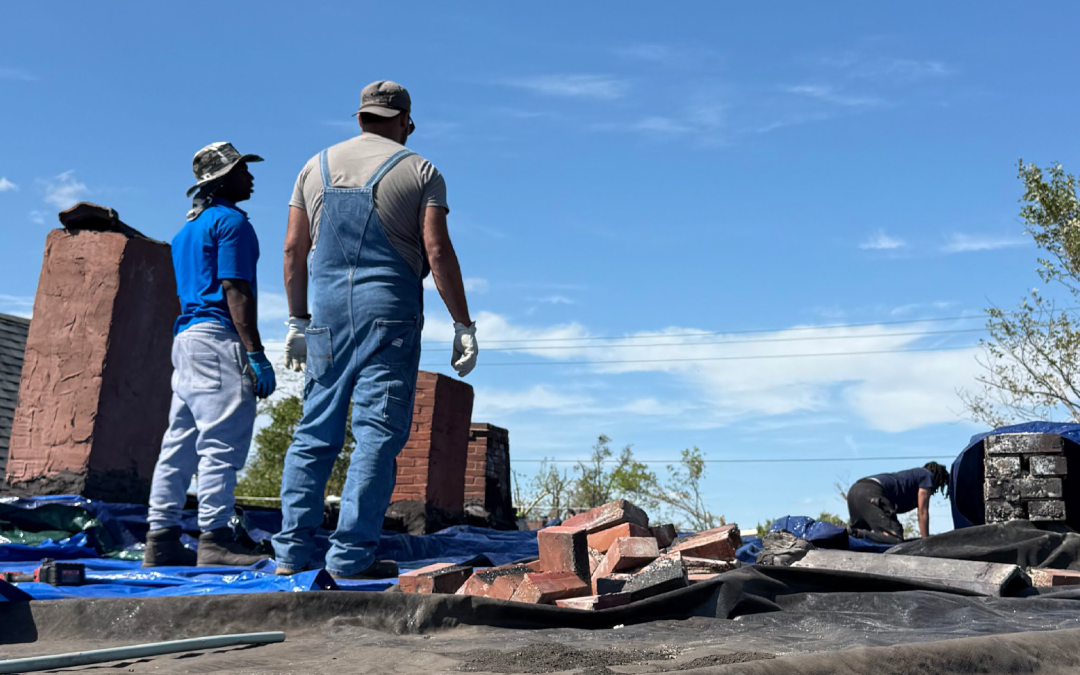
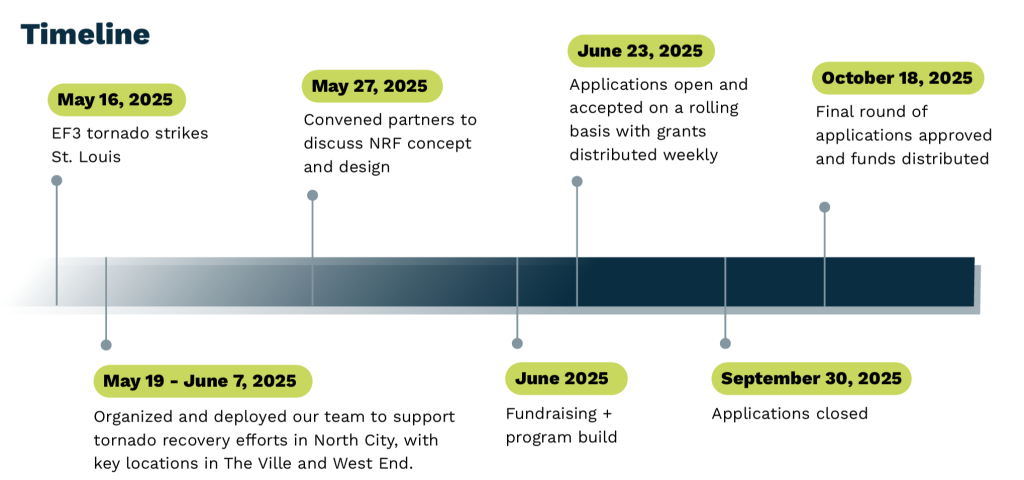
On May 16, 2025, an EF3 tornado cut a 23-mile path through St. Louis City and County. The ensuing devastation left thousands of residents displaced, destroying more than 5,000 homes and businesses. The brunt of the destruction hit 19 North St. Louis City neighborhoods — Legacy Black communities from which investment and opportunity have historically been withheld. In the weeks that followed, federal, state, and municipal systems slowly mobilized — but, as is often the case after large-scale disasters, a gap emerged between the impact and the relief.

Direct Cash Assistance, Designed for Urgency, Flexibility, and Agency

Launched by Invest STL in partnership with community organizations and funders, the Northside Resilience Fund (NRF) provided direct, flexible cash assistance to households in North St. Louis, our neighbors most severely impacted by the tornado. The goal was not to replace longterm recovery resources, but to meet urgent, immediate needs as residents waited for insurance, the Federal Emergency Management Agency (FEMA), and other relief to become available. This required building a program — intake, review, verification, distribution, and support — in real time. This work was based on past experiences launching direct cash assistance initiatives, including a COVID-19 aid fund, Rooted: Cultivating Black Wealth in Place, and Small Dollars Action Fund.

In just two weeks, we and our partners created and raised enough initial funding to launch a direct cash assistance program. On a rolling basis over the course of four months, 1,378 North St. Louis households received $3,000 grants to begin their recovery on their own terms — for housing, transportation, utilities, repairs, medical needs, and much more to create a path toward recovery.

This Powerbook Documents What It Took to Do That Work.

This Powerbook captures how NRF came together, how decisions were made under pressure, what worked well, what did not, and what we could — as well as the broader region could — do differently next time. It draws directly from listening sessions with the people who made NRF possible: project leads, volunteers, phone helpline members, and application review staff who shouldered the work daily.

NRF was created to meet urgent needs quickly — and to trust residents to decide what came next.

NRF was not perfect. No rapid-response program ever is. But it demonstrated what is possible when community-based organizations are trusted, resourced, and equipped to act quickly, with care for neighbors and their dignity.

The speed and scale of this work exposed both strengths and strains — lessons that inform how we, and our region, can respond more quickly and equitably with direct cash assistance during future disasters and crises.

Preparing for What Comes Next

Extreme weather does not affect all communities in the same way. Predominantly Black neighborhoods are often hit hardest, as climate-related disasters compound the injustices of historic housing discrimination and systemic racism. (1) Research has shown that formerly redlined neighborhoods experience greater vulnerability to extreme weather than non-redlined areas. We see this nationwide, as Black neighborhoods denied investment are hotter and more flood-prone than wealthier, whiter neighborhoods. (2)

We are dedicated to untethering the past from what’s possible in the future by refusing to accept the restraints of generations of systemic anti-Black racism. As extreme weather events become more frequent and severe, the lessons from NRF are not just retrospective. They are preparatory. This Powerbook is intended to serve as a practical resource for our Invest STL team, community organizations, funders, and government leaders working to ensure the next direct cash assistance response is faster, more equitable, and better coordinated.

1: The Effects of Historical Housing Policies on Resident Exposure to Intra-Urban Heat: A Study of 108 US Urban Areas,” published in Climate (2020).

2: “A Racist Past, a Flooded Future: Formerly Redlined Areas Have $107 Billion Worth of Homes Facing High Flood Risk—25% More Than Non-Redlined Areas,” Redfin News (2021)

Reflections on 2024: Slow + Steady, Activation + Preparation

Reflections on 2024: Slow + Steady, Activation + Preparation

By: Dara Eskridge, CEO

Quiet as it’s kept, we’ve been up to a lot at Invest STL. For those closest to us, you already know we have grown significantly since our first forming in 2012. During the height of the pandemic, we wholly embraced a more pointed mission to facilitate investment in the power of people and their neighborhoods to create communities of justice and opportunity in places that continue to endure the legacy of systemic anti-Black racism. With this mission, we committed to working urgently, boldly, and intentionally to support system-level transformation within a generation and set our organizational clock to shut our doors by 2042.

At the core of this mandate is our devotion to rigorous self-examination and transparently sharing with our community our learnings and trials along the way. Here is the beginning of our open conversation with you as we strive together to make every St. Louis neighborhood a chosen place to live, raise children, and grow old.

Reflections on 2024

Since we started our 20-year organizational sunset clock in 2022, we have been in the “Activate + Prepare” phase (stay tuned for the full roadmap this year). We made significant strides in this phase during 2024, including:

  • Continued building our internal infrastructure;
  • Continued establishing and fortifying key relationships and partnerships within our community, from resident- and other neighborhood-based groups to local government to regional intermediaries;
  • Continued growing our investments in our region’s landscape of Black neighborhoods and the dreams and possibilities within them. 

Here are just a few ways we leaned into activating + preparing in 2024:

  • We ramped up our team from 9 to 16 deeply creative and committed professionals. This allows us to fully engage in all areas of our work, including Neighborhood Investing, System Investing, Policy Piloting + Influencing, and Narrative Reframing.
  • We developed and codified internal culture-setting practices like bimonthly team development days. These intentional development days root us in the individual histories of Black neighborhoods, foster shared skill building, and conclude with wellness excursions that invite joy and levity as core components to how we engage in this work together.
  • Through surveying neighborhood organizations and pulling from other data sources, we sought to understand and bring forth insights about what’s happening in our community through our forthcoming community and economic development ecosystem assessment. Stay tuned for initial learnings and opportunities for action to be shared in early 2025.
  • With the will and wisdom of residents and partners in the West End and Visitation Park community, we bottled ahas and guidance for supporting truly resident-led neighborhood planning in our Resident-Led Neighborhood Planning Powerbook. This comprehensive resource aims to help create the conditions for change in how places are planned for and who drives the conversation.
  • From the swelling participation of residents in 40+ neighborhoods across our region’s core, we were able to begin identifying networks of collaboration through the Small Dollars Action Fund (SDAF). Check out past SDAF projects in our Action Map.

While we experienced momentum, there are directives of this phase that didn’t receive much attention in 2024. We hold many relationships in this space, but we need to be more thoughtful about initiating key relationships that are the levers for building and sustaining generational change within our ecosystem. Likewise, it’s so easy to be zoomed into the everyday work and its…complications…that we often forget to take a step back to illuminate the bright spots through rich storytelling or simple applause and acknowledgement. We are committed to giving more time and care to these intentions in 2025. 

On that note, there are moments when “enough” feels elusive—“Do we have enough time?” “Do we have enough capacity?”Is this enough to really make a difference?” As our organization rounds into our final moments to Activate + Prepare” our foundation, I am reminded that taking fewer yet giant steps in this phase will yield the space for rapid strides in our next phase of Experiment + Model.”

Over the next year, the mostly quiet and patient work of the last three years will give way to what we hope is an explosion of efforts across our region to try new ways of accelerating wealth, power, and collective action to the benefit of our legacy Black neighborhoods and beyond. 

Looking Ahead

You can look forward to hearing from us in 2025 on: 

  • The release of the Rooted: Cultivating Black Wealth in Place Powerbook, which will reflect our learnings and guidance on direct cash investments to people to support community-keeping through wealth building.
  • For the first time since 2018, the inclusion of more neighborhoods where we are honored to build longer-term, deep investment relationships.
  • The opening of our new community space and office in the heart of the Northside as an ode and offering to invite, memorialize, and amplify the multifacetedness of living in this beloved community. We will continue to have our office on Delmar. 

From upcoming local elections to national trends making their way to the heartland, there’s a wave of new developments that stands to significantly impact life and what’s possible in our neighborhoods in the near future. With 18 years remaining in our mission relay—just seconds in the long arc of collective changemaking—we’re rounding the corner to the stretch where quiet as it’s kept and slow and steady will no longer serve our commitment to facilitate a system that will be directed by and to the benefit of residents within a generation’s time. 

Learn more about where we’ve been from our 2024 Reflection and sign up for our newsletter to stride with us as we lace up for an even more dynamic 2025.


How West End residents took control of their community’s future development

How West End residents took control of their community’s future development

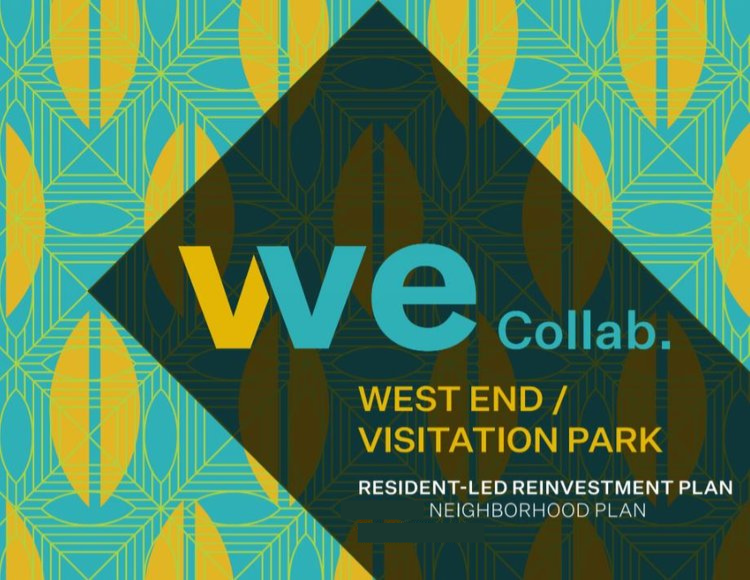
WeCollab hit a critical milestone in their journey to bring resident vision and leadership into their community’s planning and development conversation. On June 14, 2023, the WeCollab Neighborhood Plan was adopted by the City of St. Louis’ Planning Commission as a Neighborhood Plan and a supplement to the City’s Comprehensive Plan. On the heels of this historic moment, WeCollab steering committee member Lisa Potts and lead neighborhood ambassador April Walker, sat down with St. Louis On the Air to talk about their journey and what it means for the West End and Visitation Park neighborhoods. Invest STL’s executive director Dara Eskridge also joined the conversation on St. Louis Public Radio to share more about our organizations role in creating a neighborhood-level investment strategy that is both monetary and programmatic. Read more and access the on-air segment at: https://news.stlpublicradio.org/show/st-louis-on-the-air/2023-06-16/how-west-end-residents-took-control-of-their-communitys-future-development

WeCollab Resident-led Neighborhood Plan – A New Standard

WeCollab Resident-led Neighborhood Plan – A New Standard

The adoption of the WeCollab neighborhood plan is historic for what it is and how it was conceived; its authentic commitment to making real the vision and initiatives that residents want to see is a signal to the larger ecosystem that a new approach is already making a positive impact. At the June 14th hearing, St. Louis City’s Planning Commission adopted the neighborhood plan to great applause from a packed room of neighbors, partners, and supporters. The city planning department had been engaged early in the process in the development of the draft, which helps increase the efficiency of assessing proposals when they get to this stage of development. These coordinated efforts grew through a collaborative process that extends back through years of relationship and partnership building between residents, neighborhood partners, funders and facilitators, technical support partners, city agencies and department partners, all sharing their expertise, listening, and supporting a resident-led plan and planning process.

What does resident-led planning look like and what does this impact mean for residents and our broader community and economic development ecosystem? Hear it in their own words, below are a few snapshots from WeCollab resident leaders and our team member reflecting on their trip to Charlotte, NC, to receive a Charter Award from the Congress for the New Urbanism.

We also invite you to watch this fine video WeCollab Wins CNU Award produced by YARD & Company, WeCollab’s planning partner, showcasing the neighborhood, residents, and the power of people in the West End and Visitation Park collaborating to create a new standard. 

“The WeCollab planning process has set a new standard for community engagement within the Congress for New Urbanism.” Megan O’Hara, CNU Jury Chair. Principal and Partner, Urban Design Associates

From St. Louis, MO to Charlotte, NC – a snapshot from April Walker, WeCollab Community Ambassador

When Kevin from YARD & Company, our planning partner, first told us that we would be receiving an Award way back in February, I started making plans to attend. My mom and both of my daughters are also WeCollab Community Ambassadors and they wanted to go as well, so we booked an Airbnb in Charlotte. I was so excited I told my other family members, and they made plans to attend as well. In total, eight family members, all the way from Washington state to Alabama attended this award ceremony with us.

While at the airport to pick up the rental car, the attendant asked me where we were going, and I explained to him about the award. He said, “That is so cool! Congratulations on the work you are doing.” Once we arrived in Charlotte, every restaurant, the mall, ice-cream shop we went to, we told people why we were in Charlotte and about the award. It was so nice telling people and everyone was really complimentary.

At the award ceremony itself, what struck me was that we were the largest group there. We were the best dressed group and – we were the only group that had a resident-led plan. We were in the room with developers, architects, city planners, students, professors, even a mayor, but no one had residents or the people who were going to be the recipients of those plans in attendance. Several people came up to me afterwards and said, “Wow, I guess a resident-led plan is the way to go,” or “that is really an innovative way to look at city planning.” You could tell that the thought of having a community involved from start to finish was just something they had never even given a thought. They seem interested now, seeing our process. My family members too, on seeing the video remarked how they were going to take what we were doing back to their hometowns. They are showing the video at their community meetings.


From St. Louis, MO to Charlotte, NC – a snapshot from Lorin Lennon, Invest STL Collaboration Support Partner

As we touched down in North Carolina and began navigating Charlotte’s airport, I felt a sense of purpose to our being there. We’ve been moving together throughout this whole journey; walking together, discovering, developing a resident-led neighborhood plan – now we have the opportunity to celebrate and share our very local heart work with an international audience.

Landing comfortably towards the front of the auditorium at the CNU Chart Awards ceremony, that sense of purpose called out with a unique sound, tones of openness, pride, class. I felt among greatness. On my right was a member of our team, Alexa Seda, Senior Planner at the City of St. Louis, while to my left was the student winner, an Ethiopian girl who designed an entire neighborhood following culturally significant traditions and local materials. It reminded me of the study I had done not too long ago with African architects, builders, designers, and artists about designing in culturally relevant ways. In the United States, we may not all be tied to our definitive ethnic roots, but we have created a culture worth celebrating, designing in, and upholding in how we practice. It was inspiring to notice the variety of people and places represented and just how widespread this work and movement is. Recognizing where the projects were based, some of the firms behind them, and my own personal resonance with New Urbanism principles and these real-life examples was energizing. I mean, I didn’t know New Urbanism was a ‘thing,’ but I think we are practicing elements of it every day. So much of what I aspire to for society and urban life, this movement captures. It was fun to learn about something new, and I’m already a part of it!

From the Award Ceremony we enjoyed a brief walk to a nearby restaurant. We passed a park that was created through a collaboration between the University of North Carolina and the City of Charlotte. Urban planning professors and students worked together to activate the space that had sat unoccupied for years near the DeBois Center where the ceremony took place. Our walk was active, passing people from all walks of life that I wouldn’t typically expect to see in a place like this. It signaled to me that the members of the CNU practice what they preach and consider something for everyone to share and take part in. Our team was so excited and continued to celebrate how good we looked together and how good it felt to be honored for our collaborative vision and effort. We arrived at the restaurant to discover that it was a black owned, more icing on the cake, and a perfect place to land and wrap up the evening with great food, a beautiful atmosphere, and jamming music. Camaraderie, laughter, and joy filled us up.


From St. Louis, MO to Charlotte, NC – a snapshot from Lisa Potts, WeCollab Steering Committee Member

Everything about our trip to Charlotte was inspiring as I considered what the West End and St. Louis can be. From the moment I stepped off the plane I felt I was on an adventure. I immediately began comparing what I was seeing and experiencing to home.  It made me think about who were the leaders in Charlotte?  Were any residents at the table for the decisions that were made here? 

As we walked through the airport, I remember being so proud of why we were there.  We told everyone we met that we were there to receive an award for our neighborhood planning work. The evening of the awards we stood out because we had one of the biggest groups in attendance, we were so happy to be together for this honor, and we were all dressed so formally. People seemed genuinely impressed by our accomplishment, for some folks you could tell it was a new idea, residents leading a planning effort.

I loved that they had an African American Cultural Museum in the heart of their downtown.  Their streets were clean and pedestrian friendly.  The place I was most impressed by was the park in the middle of downtown – it had beautiful art and sculptures representing several cultures. The lights, signage, benches, and flowers added to the beauty of the environment.  It was surrounded by restaurants that reflected the different cultures of their community. It felt safe, inviting, and there was something for everyone. I saw a man praying or in deep thought near a waterfall. Others were sitting on a bench reading or engaged in conversation. I was walking around in awe and taking photos like a true tourist.  

I kept pointing out different things that excited me, sensing that level of thoughtfulness and intention and how we could absolutely have these amenities in the West End. I was glad that I had witnessed these beautiful surroundings among my neighbors, friends, and partners from home because we could all go back to our neighborhood in St. Louis and continue to dream and plan. We have all seen what is possible. Now my dream is to take a cohort of additional West End neighbors and stakeholders to visit Charlotte or similar places so we can dream in real time and plan for the future of the West End.

Invest STL Plans for the Future

Invest STL Plans for the Future

“We are grappling with, ‘How do we plan for the future of our neighborhood and its economic prosperity, and its continued call for diversity and racial equity?’ At the same time as we’re doing this, how do we prevent things like displacement from happening?”

Treena Thompson is a resident of the West End neighborhood and board member of Cornerstone Corporation. She voices concerns that resonate with many residents in her neighborhood and neighborhoods throughout St. Louis. We grapple with these same concerns at Invest STL and walk with our partners to support them designing solutions, achieving their goals, and reaching their vision.

Partners like Cornerstone STL and Dutchtown South Community Corporation are working to increase access to affordable and quality housing, medical care for residents, ridership for public transit in neighborhoods and more. And, they’re doing things a little bit differently: they’re putting residents at the center of the community development process.

To learn more about Invest STL’s approach, who we are, and to hear more from our team and partners, dive into St. Louis Magazine’s Big Think story on us, click here.

Reflections On 2021

Invest STL offers our 2021 reflection from a place of gratitude and growth. We have come a long way as we set the tone for the journey ahead. 2021 presented our growing team and vision with the opportunity to look inward and cultivate our organizational place and personality within this story that we share with St. Louis and all her residents. We have been refining our identity, dialing in our purpose, carefully considering how we will go about this journey toward a St. Louis where every neighborhood is a chosen place to live, raise children and grow old. This is our vision and the touchstone for our newly developed Theory of Change, which gathers all of those internal efforts and systematically lays out our path forward. We will share some more elements from our TOC here, including our mission + guiding principles, which help keep us in stride as we step into our newly defined way of being. Download the Reflections On 2021.pdf to get the whole story.