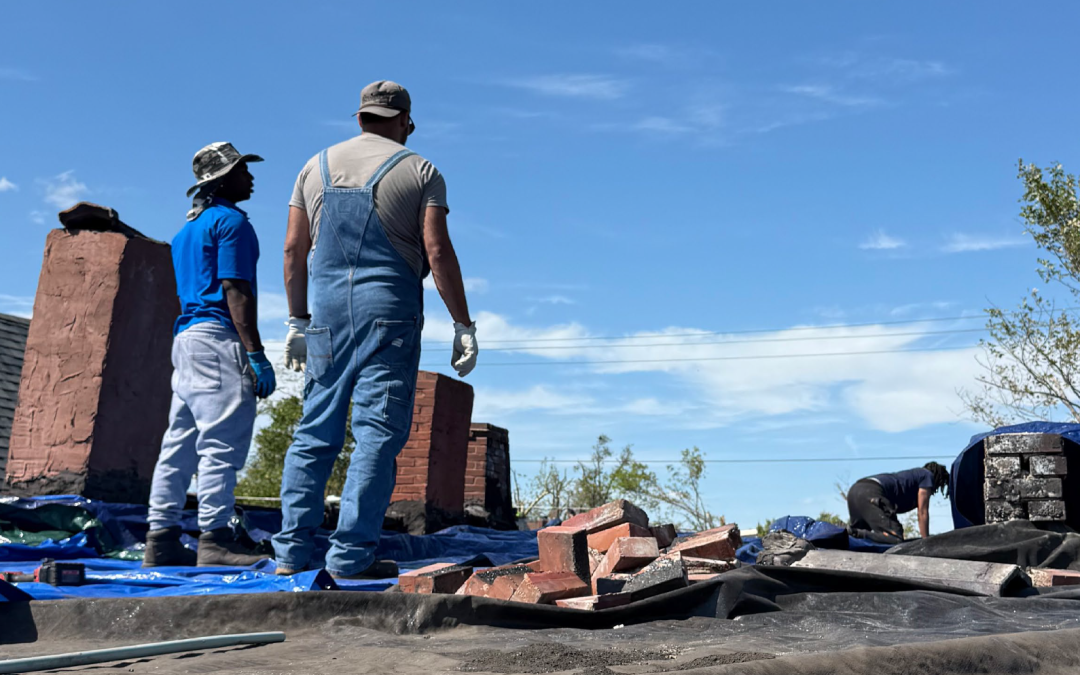
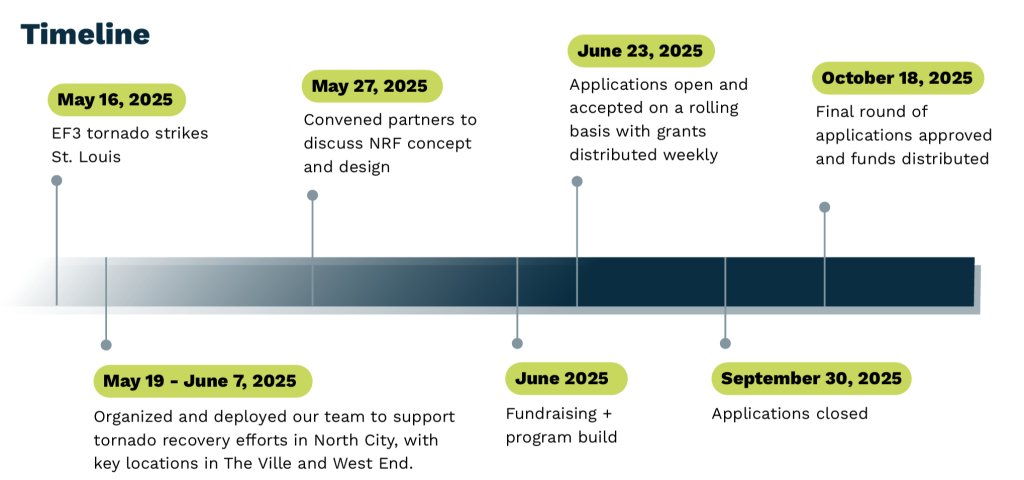
On May 16, 2025, an EF3 tornado cut a 23-mile path through St. Louis City and County. The ensuing devastation left thousands of residents displaced, destroying more than 5,000 homes and businesses. The brunt of the destruction hit 19 North St. Louis City neighborhoods — Legacy Black communities from which investment and opportunity have historically been withheld. In the weeks that followed, federal, state, and municipal systems slowly mobilized — but, as is often the case after large-scale disasters, a gap emerged between the impact and the relief.
Direct Cash Assistance, Designed for Urgency, Flexibility, and Agency
Launched by Invest STL in partnership with community organizations and funders, the Northside Resilience Fund (NRF) provided direct, flexible cash assistance to households in North St. Louis, our neighbors most severely impacted by the tornado. The goal was not to replace longterm recovery resources, but to meet urgent, immediate needs as residents waited for insurance, the Federal Emergency Management Agency (FEMA), and other relief to become available. This required building a program — intake, review, verification, distribution, and support — in real time. This work was based on past experiences launching direct cash assistance initiatives, including a COVID-19 aid fund, Rooted: Cultivating Black Wealth in Place, and Small Dollars Action Fund.
In just two weeks, we and our partners created and raised enough initial funding to launch a direct cash assistance program. On a rolling basis over the course of four months, 1,378 North St. Louis households received $3,000 grants to begin their recovery on their own terms — for housing, transportation, utilities, repairs, medical needs, and much more to create a path toward recovery.
This Powerbook Documents What It Took to Do That Work.
This Powerbook captures how NRF came together, how decisions were made under pressure, what worked well, what did not, and what we could — as well as the broader region could — do differently next time. It draws directly from listening sessions with the people who made NRF possible: project leads, volunteers, phone helpline members, and application review staff who shouldered the work daily.
NRF was created to meet urgent needs quickly — and to trust residents to decide what came next.
NRF was not perfect. No rapid-response program ever is. But it demonstrated what is possible when community-based organizations are trusted, resourced, and equipped to act quickly, with care for neighbors and their dignity.
The speed and scale of this work exposed both strengths and strains — lessons that inform how we, and our region, can respond more quickly and equitably with direct cash assistance during future disasters and crises.
Preparing for What Comes Next
Extreme weather does not affect all communities in the same way. Predominantly Black neighborhoods are often hit hardest, as climate-related disasters compound the injustices of historic housing discrimination and systemic racism. (1) Research has shown that formerly redlined neighborhoods experience greater vulnerability to extreme weather than non-redlined areas. We see this nationwide, as Black neighborhoods denied investment are hotter and more flood-prone than wealthier, whiter neighborhoods. (2)
We are dedicated to untethering the past from what’s possible in the future by refusing to accept the restraints of generations of systemic anti-Black racism. As extreme weather events become more frequent and severe, the lessons from NRF are not just retrospective. They are preparatory. This Powerbook is intended to serve as a practical resource for our Invest STL team, community organizations, funders, and government leaders working to ensure the next direct cash assistance response is faster, more equitable, and better coordinated.
1: The Effects of Historical Housing Policies on Resident Exposure to Intra-Urban Heat: A Study of 108 US Urban Areas,” published in Climate (2020).
2: “A Racist Past, a Flooded Future: Formerly Redlined Areas Have $107 Billion Worth of Homes Facing High Flood Risk—25% More Than Non-Redlined Areas,” Redfin News (2021)
As an organization committed to a clear end date (2042), we are constantly viewing time in three directions: what we seeded in the past that we can nurture in the present to yield meaning in the future. Looking back, in 2024, I was nagged by the question of enough (effort, understanding, care, ingenuity, investment, etc.). What a difference a year makes.
When 2025 began, we were rounding home on the first phase of our 20-year timeline (Laying the Foundation). It was to be a final year of slow and steady, marked by calm and clarity. But 2025 had much, much more in mind. Driving northbound to a meeting on May 16, I watched the sky turn heavy with green. Team members were watching the same from our office windows. In the miles of neighborhoods between us, in barely an hour, the very heart of Black St. Louis would be forever changed. For so many families and communities alike, plans and dreams were shaken loose and scattered with no roadmap for what was next. But the years of forged relationships, shared memories, kind gestures, and aligned purpose remained in the soil. And like those families, thousands of neighbors, and countless organizations, we put it all to work.
Freshly inked investment partnerships were leveraged to provide collective care through the 4theVille Emergency Hub, anchored by 4theVille, Invest STL, and Dream Builders 4 Equity in daily collaboration with Action St. Louis and ForTheCultureSTL for The People’s Response. Instead of launching new pilots as intended, we doubled down on our learnings from previous efforts and launched the Northside Resilience Fund with capital from longtime backers and new supporters, all seeking to provide timely, flexible cash aid for our neighbors navigating the unimaginable. And the Small Dollars Action Fund, delivered in partnership with SLACO, was a steady source for residents organizing, showing up for, and doing as they saw best for their neighborhoods. The pace and scale at which we’ve tried new ways of doing (resident-led planning, Rooted, Small Dollars Action Fund, etc.) and accelerated development and usefulness of key relationships prepared us to be nimble and responsive immediately following the tornado. There was enough familiarity and credibility for us within the ecosystem and the community to be a collaborator and steward of meaningful action in the midst of major unknowns.
Our actions post-tornado only heightened and broadened our relationships, understanding, utility, and credibility, setting a firm foundation for our arc. Indeed, it was 85% good enough to show up with and for our community and launch us into the next phase of our 20-year timeline: rapid trying of bold ideas with purpose. Now, those careful plans that were swept up into a whirl and rightly set aside are being dusted off and retooled in a year that makes them even more relevant and urgent for the present and the future. For Invest STL, our 2026 forecast includes:
A compliment to the continuum of resident-focused trainings offered in the region by way of our place-based Neighborhood Action Incubator to strengthen and catalyze networks of residents organizing and moving together to shape their neighborhoods
Our first trying of a Neighborhood Storytelling Practice, a collective-centered invitation for residents to uncover, bring forward and amplify their own experiences of being in and keeping a place together
A pilot effort to restore value to homes in legacy Black neighborhoods, with the intentions of providing families with the equity needed to affirm home as their generational wealth cornerstone
Elasticity and spaciousness to show up and do as best we know how alongside so many other committed organizations and residents, to forge a future for North City, unfogged by the tornado’s debris
It turns out just enough was there all along, waiting to prove itself when the time called for it. Our foundation is set, firm enough yet a little spongy for the give that’s required to be the most useful with what and who we have in responding to the moment at hand, while not losing shape or intention for our mission. In 2025, practicing our principles and not sticking to rigid formulas revealed the integrity of what we’ve cultivated so far. In 2026, it will illuminate the new possible, one untethered from the past and reaching toward a community worthy of our lifetime.
“This is not just a dream or something that is so far away that you can’t reach. This is happening in our community and it’s happening with people that are here.” – Star Stinson, West End resident and Rooted participant. Watch the Fox 2 story to learn more about Rooted: Cultivating Black Wealth in Place and how the new initiative from Invest STL is supporting residents’ ability to stay and grow in the place they call home.
The Rooted initiative hopes to create “a multi-generational approach to wealth building” by providing $20,000 to 50 participants that live in the city’s West End or Visitation Park neighborhoods who applied and qualified for the grant. Each participant will have access to free services including financial planning, credit counseling, and estate planning. Click here to read the whole article from the St. Louis American.
In recent years, the West End and Visitation Park neighborhoods of St. Louis have begun to see signs of gentrification. These historically Black communities are experiencing increased economic investment, rising rent and housing prices, and a growing white and higher-income population. Absent any intervention, these forces of economic development and chance could displace long-time Black residents.
However, one nonprofit community development intermediary and funder in St. Louis, Missouri, Invest STL, is piloting Rooted, Cultivating Black Wealth in Place, an initiative aimed at combating displacement in two historically Black neighborhoods. The Urban Institute is evaluating the program to assess its impact on displacement risk and wealth building. The analysis will also uncover financial planners’ role in helping beneficiaries pursue these outcomes. And if this pilot is successful, scaling it could help address the racial wealth gap more broadly. Click her to read the whole story from the Urban Institute’s blog Urban Wire.